


The Obscura
Designed as a complementary instrument for Emocean boats.
Time is direction. Precision is freedom.
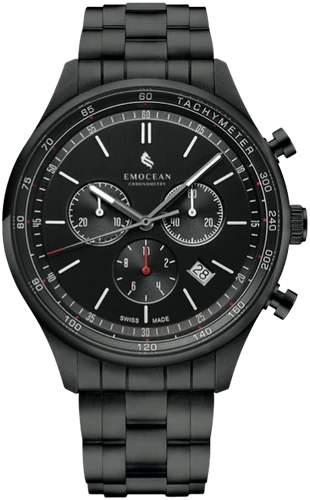
Before satellites, a navigator found the boat's position from three things: heading, speed and time. Of the three, time is the one you can measure most precisely with no electronics at all. The Obscura is a Swiss-made chronograph built around that idea: an instrument that keeps working when the screens don't.
On the water
Why a chronograph is a navigation instrument
Dead reckoning
Distance is speed multiplied by time. Start the chronograph as you pass a known mark, hold a steady heading and speed, and the elapsed time gives you the distance run: 24 knots for 15 minutes is 6 nautical miles. Lay that off along your heading from the mark and you have an estimated position, without GPS.
Speed by tachymeter
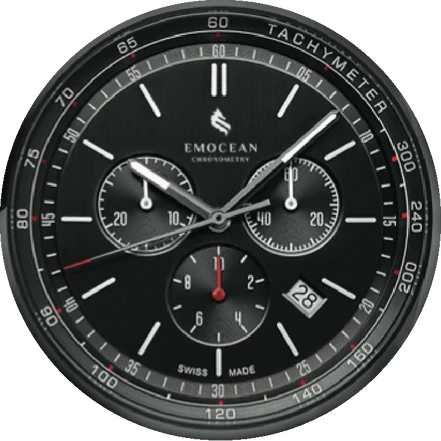
Start the chronograph at one marker and stop it at the next, one nautical mile on. The tachymeter bezel turns the seconds straight into knots: 120 seconds over the mile reads 30 knots. It is the quickest way to check a log, a speedometer or a GPS reading you don't trust.
The sun as a compass
In daylight the watch gives you a bearing. Northern Hemisphere: point the hour hand at the sun; south lies halfway between it and 12. Southern Hemisphere: point 12 at the sun; north lies halfway between 12 and the hour hand. Under daylight saving time, use 1 instead of 12.
Fuel and range
Time each leg against the engines' known burn rate and you know what is left in the tanks, independently of a sender gauge that can read wrong in a seaway.
Tides and currents
Time the turn of the tide, or your drift against a fixed mark, and you know how much the water itself is carrying you, and in which direction.
Watchkeeping and the log
Watches, crew changes, waypoints and every entry in the log depend on accurate time. A chronograph on the wrist keeps them honest when the boat's power is down.
A worked example
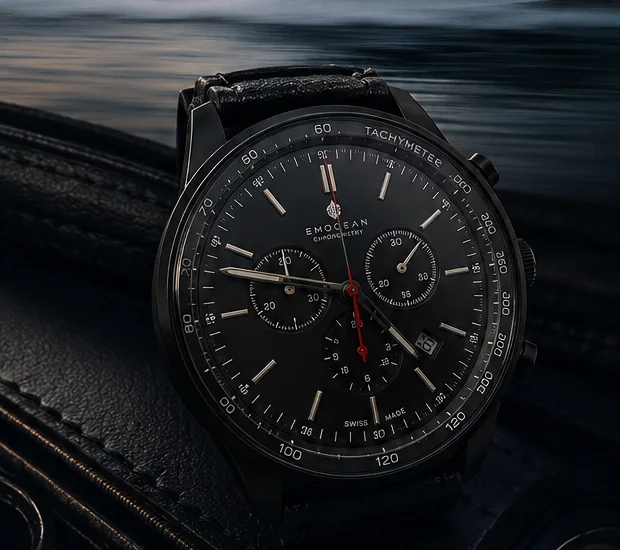
Leave the harbour light abeam. Start the chronograph. Heading 270°, 24 knots.
Elapsed 15:00. Distance run: 24 × 0.25 h = 6 nm. Plot 6 nm west of the light.
Pass a charted buoy, then the next, a mile apart, in 2:30. The tachymeter reads 24 knots: the speed is confirmed.
Using the chronograph
The pusher at 2 o'clock starts and stops the chronograph. The pusher at 4 o'clock resets it to zero.
Emocean Chronometry
A backup, not a replacement
The Obscura does not replace a chart plotter or a magnetic compass, and the sun method is approximate. It is least reliable around midday and in the tropics in summer, when the sun stands high, which in the Gulf is much of the year. Its value is redundancy: an independent instrument that still works when the electronics don't.
Specifications
- Movement
- Swiss quartz, Ronda cal. 5040.D
- Functions
- Chronograph, tachymeter, date
- Case
- 42 mm × 11.8 mm, black PVD stainless steel
- Crystal
- K1 mineral glass, sapphire coating
- Dial
- Black
- Water resistance
- 10 ATM / 100 m
- Bracelet
- Steel, leather or rubber, black
- Battery
- Approx. 54 months
- Warranty
- 2 years

Designed in Abu Dhabi · Swiss Made
Built to navigate. Made to endure.